Summary
-
Polymarket trading volume and active users have generally risen in tandem. The platform is not simply driven by a small number of whales inflating activity, though retention still clearly follows attention cycles.
-
The increase in fees and revenue comes from both trading demand and the gradual expansion of fee coverage and pricing mechanisms since Q1 2026.
-
Trading activity is highly concentrated in a few high attention categories such as politics, sports, and geopolitics, while long tail categories have yet to independently sustain overall liquidity.
-
Polymarket functions as both an information market and a sentiment market, but at present it behaves more like an event driven trading venue activated during high attention windows.
-
Gate’s prediction product is not a simplified onchain replica. Instead, it addresses different challenges in account integration, onboarding friction, user conversion, and product distribution.
Introduction
As of April 2026, Polymarket’s trading volume and fee generation are both at historical highs. The platform has evolved from an early onchain experiment into an event market capable of absorbing large scale trading flows across politics, sports, macro, and geopolitical events.
The focus here is not to restate what a prediction market is, but to address four more specific questions. First, is Polymarket’s growth structural in nature? Second, is the expansion in fees and revenue driven by demand or by rule changes? Third, what are users actually trading? Fourth, why are leading exchanges such as Gate beginning to incorporate prediction products into their own trading systems?
Based on these questions, this article reexamines Polymarket through data, comparison, interpretation, and judgment.
Trading and Activity
Polymarket trading volume shows a clear stepwise upward trend. Monthly volume was only $38.9 million in April 2024 and rose to $59.2 million in May. By October 2024, it had surged to $2.28 billion, reaching $2.577 billion in November. Although December declined to $1.7 billion, it remained far above mid year levels.
Entering Q4 2025, the platform moved into another acceleration phase. Monthly volume increased from $4.1 billion in October 2025 to $10.57 billion by March 2026. In terms of scale alone, Polymarket is no longer an experimental onchain niche product. It has developed into an event driven trading market that can be compared with some mature trading venues.
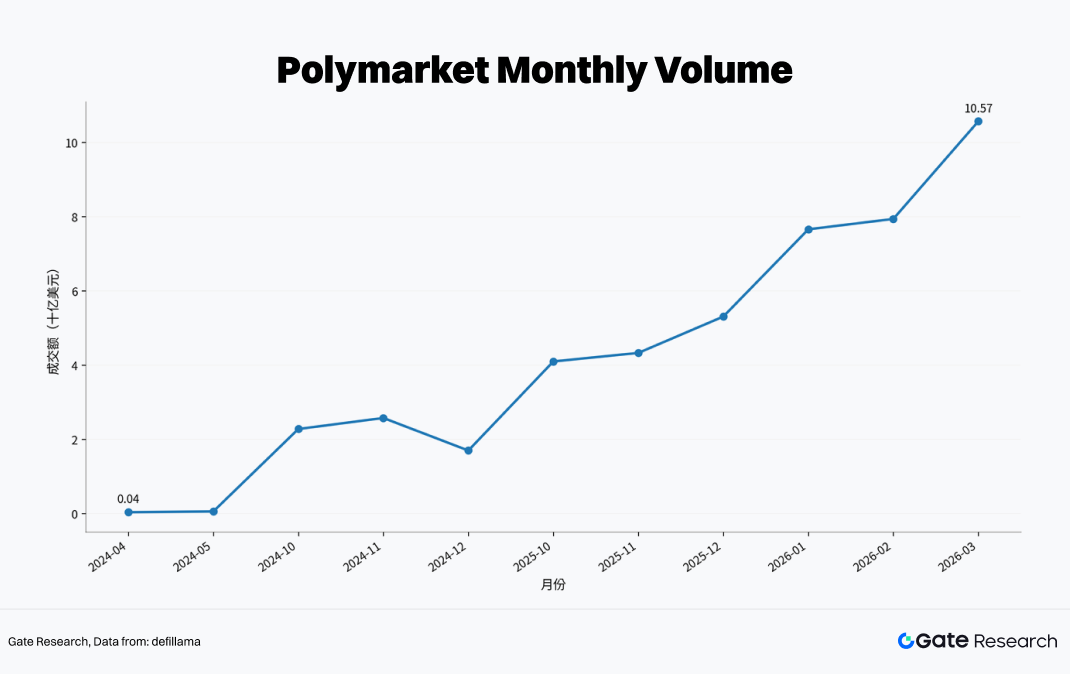
Polymarket’s growth curve reflects the combined effect of event driven demand and the platform’s capacity to absorb flow. The sharp surge from October to November 2024 was closely aligned with trading activity around the election cycle, while the renewed expansion from Q4 2025 through Q1 2026 was driven by a mix of sports, macro, financial, and geopolitical themes. The platform has shifted from relying on a single breakout event to a rotation across multiple high attention categories.
The expansion of active users has moved in step with trading volume. Monthly active traders were only 41.3k in July 2024, rising to 293.7k by November 2024 and reaching 462.6k in January 2025. After a temporary pullback in mid 2025, activity recovered to 477.9k in October 2025, and the latest monthly active figure now stands at 764.7k. In other words, the growth in trading volume has been accompanied by a steady expansion of the user base.
At the same time, the data clearly shows strong cyclicality in user activity. When attention fades, retention declines. This suggests that while the user base is becoming broader, loyalty and habitual usage are not yet strong enough to fully offset the impact of major event cycles.
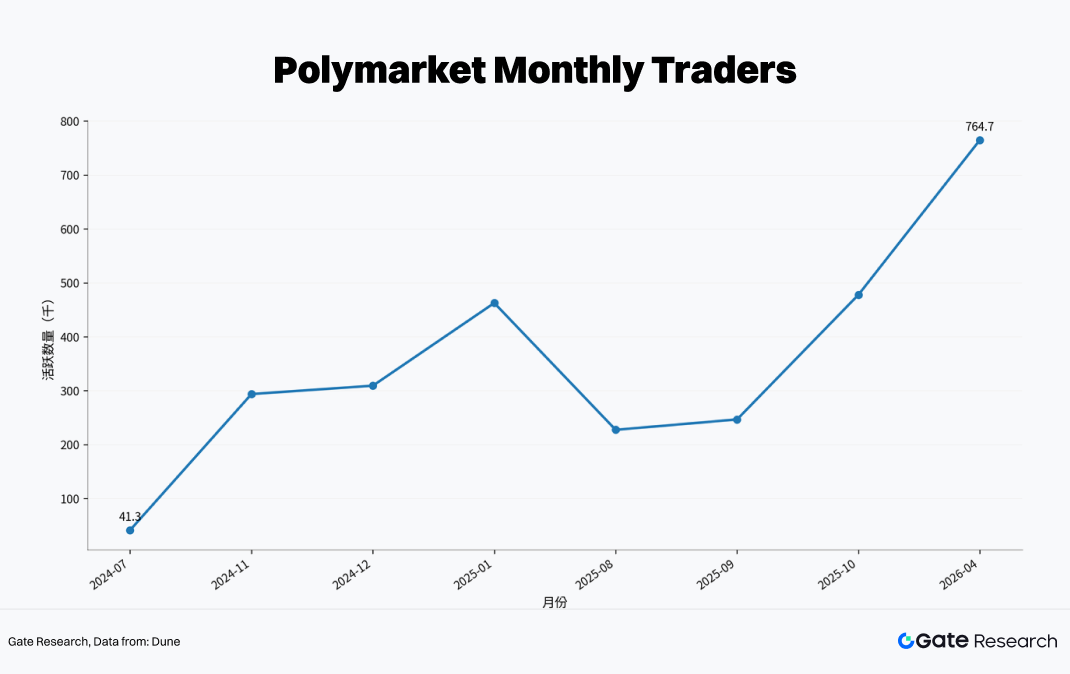
Overall, Polymarket’s growth appears relatively genuine, but it is better understood as structural expansion layered on top of event driven shocks. The platform has demonstrated its ability to absorb traffic during major information windows and convert it into trading activity, but it has yet to prove that it can sustain the same steep growth trajectory in the absence of strong narratives.
Fees and Revenue, Interpreting High Income with Caution
Compared with trading volume, Polymarket’s fee data requires more careful interpretation. First, the fee framework itself has undergone changes. According to official documentation, Polymarket uses a dynamic pricing model that charges only takers, with different rates across categories. Geopolitics and world events currently remain at zero fees. This means fee growth is not purely a function of demand, but is also directly influenced by the expansion of fee coverage and adjustments to the pricing structure. Annualizing the fee curve without accounting for these changes risks mistaking rule driven shifts for permanent improvements in operating performance.
A key inflection point in fees appeared around late March 2026. Publicly verifiable data shows that gross protocol revenue in Q1 2026 reached $16.23m, while fees over the most recent 30 days as of early April reached $14.75m, with revenue at $10.36m over the same period. Following the expansion of fee coverage on March 30, the first full week generated $6.8m in fees, and daily fees briefly exceeded $1m on April 1.
The scale of fees over the past 30 days is already approaching the revenue of a full prior quarter. While this reflects strong trading demand, a more important explanation is that a large volume of previously unmonetized event trading has now been brought into the revenue framework. As a result, the revenue curve shows a step change, which should not be simply interpreted as a sudden doubling of underlying demand.
In this sense, current fee levels are driven by both demand and rule changes. The former reflects the platform’s ability to generate significant event driven trading flow, while the latter reflects the gradual activation of monetization. From an operating perspective, these two drivers should not be conflated. Extrapolating annual revenue into the hundreds of millions based solely on single day fees exceeding $1m overlooks two key constraints. First, higher fee rates may compress high frequency trading and market making activity. Second, the most attention grabbing categories, particularly geopolitics, still operate at zero fees, meaning the largest pools of traffic do not necessarily convert proportionally into protocol revenue.
Therefore, the fee curve primarily shows that the platform has proven it can charge fees, indicating that the business model is beginning to take shape. However, whether high revenue levels can be sustained and replicated over time will depend on trading composition, market making incentives, fee elasticity, and user response.
Market Structure and Event Concentration
Polymarket is far from a broadly diversified market. Politics, sports, and geopolitics alone account for 92% of total volume across major categories. When compared with smaller segments such as culture, economy, crypto, weather, and finance, it becomes clear that while long tail markets exist, their contribution to overall trading remains minimal.
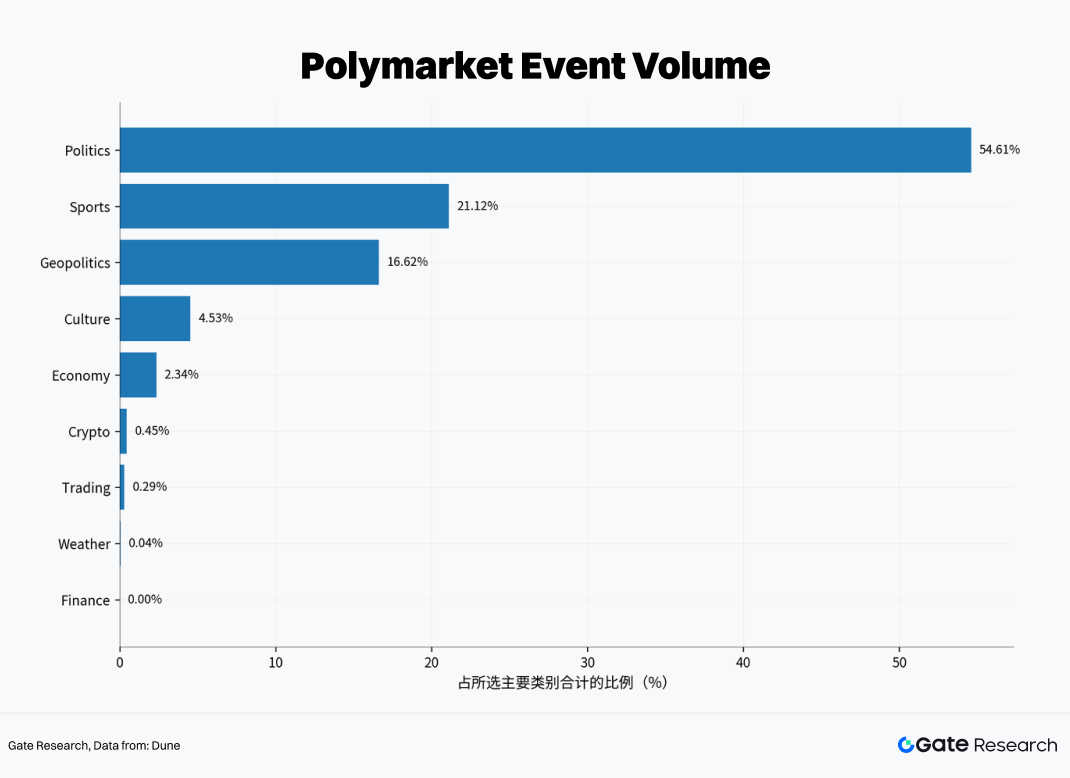
Polymarket’s core demand does not come from the universal idea that anything can be priced, but rather from a small set of high attention, high controversy, and frequently updated information categories. Users are most willing to trade events with strong media amplification and clearly defined resolution points. Politics, sports, and geopolitics dominate because they combine narrative intensity, continuous information flow, and clear settlement outcomes. Although the platform appears to be an open market, in practice it functions more like a collection of top tier event markets. As long as strong headline events continue to emerge, liquidity will concentrate around them. When event supply weakens, long tail markets struggle to sustain overall activity on their own.
This structure also introduces risks. Highly concentrated markets tend to achieve deeper liquidity and more efficient price discovery around major events, but they are also more dependent on the supply side. While there is room for category expansion, actual trading remains heavily reliant on a few core themes. This means sustainability depends not only on user growth, but also on the platform’s ability to continuously introduce new high attention events that are both tradable and clearly resolvable.
Trading Behavior and Time Distribution
From a product perspective, prediction markets are often described as information markets, where prices compress dispersed information into probabilities. On Polymarket, this characterization is only partially accurate.
On one hand, weekends do not imply inactivity. On a Sunday in January 2026, total daily volume across prediction markets exceeded $814m, with Polymarket contributing about $127m. During geopolitical trading windows in March 2026, the platform, alongside other 24 hour crypto venues, absorbed risk expression while traditional markets were closed.
On the other hand, thinner weekend liquidity remains a reality. There were cases in January 2026 where traders exploited weaker liquidity to move short duration price markets. This suggests that weekend trading tends to exhibit an uneven structure, with sharp spikes during active events and shallow depth when events are absent.
A more accurate view is that Polymarket operates as both an information market and a sentiment market, with the latter still highly prominent. It can compress news, opinions, narratives, and odds into tradable prices, reflecting its information market function. At the same time, its strong dependence on attention cycles and collective narratives means it is not a purely rational information aggregator. Price discovery is most effective during high attention periods.
Positioning Within the Market
Polymarket is often compared with three categories: DEXs, sports betting platforms, and perpetual futures. It does not fully match any of them.
It is not a DEX, because the underlying assets are not generic tokens but conditional outcomes tied to discrete events. It is not traditional betting, because positions can be traded freely before resolution and prices reflect continuous probability updates. It is not a perpetual futures market, because the core mechanism is not leverage and funding rates, but time bounded probability trading around specific events.
A more fitting definition is an event derivatives market or an information trading market within crypto. It transforms macro, political, sports, and sentiment driven events into tradable contracts that can be listed, matched, and exited before settlement. It does not replace spot or futures markets, but introduces a new tradable object: future states of the world. This is why it attracts attention during macro turning points, election cycles, major sporting events, and geopolitical conflicts, where probability based pricing naturally expresses divergent expectations.
This defines its role within the crypto ecosystem. It primarily serves information expression, attention monetization, and event risk pricing rather than asset allocation. As long as this function exists, it will not fit neatly into traditional trading categories. At the same time, its dependence on event flow makes it difficult to achieve the same level of stable, routine demand seen in spot or perpetual markets.
Observations on Gate’s Prediction Product
Gate’s entry reflects that prediction markets have entered the product expansion logic of trading platforms. According to official announcements, Gate has integrated a Polymarket entry within its app, offering both prediction mode and trading mode. Users can participate with USDT through exchange accounts or use Web3 wallets with USDC on Polygon. The key design is to transform what originally required wallets, networks, stablecoins, and onchain interaction into an experience closer to spot trading accounts.
Centralized platforms are not building weaker onchain copies. They are solving a different set of problems. The first is custody and account structure. Polymarket emphasizes self custody and onchain settlement, offering openness, transparency, and composability. Gate’s approach consolidates funds, positions, orders, and settlement within an exchange account, significantly lowering the learning curve.
The second is onboarding friction. For existing exchange users, entering prediction markets directly with USDT and existing accounts is much smoother than setting up Polygon wallets and USDC. The third is liquidity organization. Onchain markets benefit from open matching and external market making, while centralized platforms excel at directing internal user flow, order book interfaces, charting tools, and trading habits into new products, reducing cold start friction.
The advantages are not symmetrical. Polymarket benefits from verifiable onchain positions, higher openness, and easier integration for external developers and market makers. Gate benefits from lower education cost, lower switching friction, and higher conversion efficiency, making it more effective at onboarding existing spot and derivatives users into event trading. The regulatory boundaries also differ, with onchain platforms emphasizing open infrastructure and global liquidity, while centralized platforms manage visibility and access based on regions and account systems.
Gate’s prediction product signals a divergence into two distinct product paths. Polymarket emphasizes onchain openness and native information trading, while Gate focuses on low friction access, account integration, and user conversion. These approaches are likely to coexist across different user segments and regulatory environments.
Risks, Constraints, and Future Evolution
Externally, regulation remains the primary constraint. In November 2024, French regulators pushed for geoblocking, and by April 2026, the CFTC initiated legal action to assert federal jurisdiction over prediction markets. Together, these developments show that classification remains unresolved across regions, whether as derivatives, betting, or information tools. This classification will directly impact user access, event listings, and settlement frameworks as the platform expands into mainstream financial contexts.
Internal structural risks are also significant. First is resolution and oracle risk. While Polymarket uses clear rules and UMA Optimistic Oracle, complex events and ambiguous wording can still lead to disputes. Second is liquidity concentration. Trading remains dependent on top events, exposing the platform when event supply weakens. Third is fee instability. While monetization has been proven, revenue remains sensitive to fee adjustments, and high fees may reduce market making and high frequency activity. Fourth is retention uncertainty. Many users arrive for specific events but may not remain once attention fades.
Future evolution depends on whether event trading can move from episodic peaks to more stable usage patterns. This requires improvements in market creation and resolution quality, expansion into more sustainable categories beyond one time events, and a better balance between fees, market-making incentives, and user experience. Only then can Polymarket evolve from a high attention product into a more durable trading category.
Conclusion: Value and Boundaries
Polymarket has already demonstrated three things. It is no longer a fleeting onchain experiment, but a platform with real trading scale, real user growth, and proven monetization. Its growth is not purely inflated, as active users and volume have risen together, indicating that activity is not driven solely by a small number of large traders. It has also established a clear and scarce position in crypto by making future events tradable.
At the same time, three things remain unproven. High growth does not mean demand has become independent of events, as activity is still driven by politics, sports, and geopolitics. Rapid fee growth does not guarantee stable annualized revenue, since fee expansion itself is a key variable. The platform has not yet demonstrated that it can become a stable, low volatility, high retention product, and remains most effective during high information intensity periods.
Polymarket’s true value lies in transforming previously non tradable events into liquid markets and demonstrating a viable path to monetization. Its boundaries lie in continued dependence on event supply, regulatory conditions, and user attention. Looking ahead, both the onchain native model and the centralized integrated model are likely to persist. The former represents open information trading infrastructure, while the latter offers lower friction distribution. The key question is which approach can first turn prediction markets from episodic peaks into a consistent, mainstream trading category.
Source:
Gate Research is a comprehensive blockchain and cryptocurrency research platform that provides deep content for readers, including technical analysis, market insights, industry research, trend forecasting, and macroeconomic policy analysis.
**Disclaimer **
Investing in cryptocurrency markets involves high risk. Users are advised to conduct their own research and fully understand the nature of the assets and products before making any investment decisions. Gate is not responsible for any losses or damages arising from such decisions.