Users searching for the SATO token usually want to know whether it is just another ordinary Meme Coin, or whether it also supports functions such as community takeover, governance participation, and ecosystem interaction. SATO’s mechanism does not focus on complex financial models. Instead, it emphasizes transparent supply, low trading friction, and a community collaboration structure.
This question usually involves three layers: SATO’s supply and distribution structure, how 0% tax and liquidity burning affect token transparency, and how SATO participates in governance, cultural communication, and onchain interaction within the Base ecosystem.
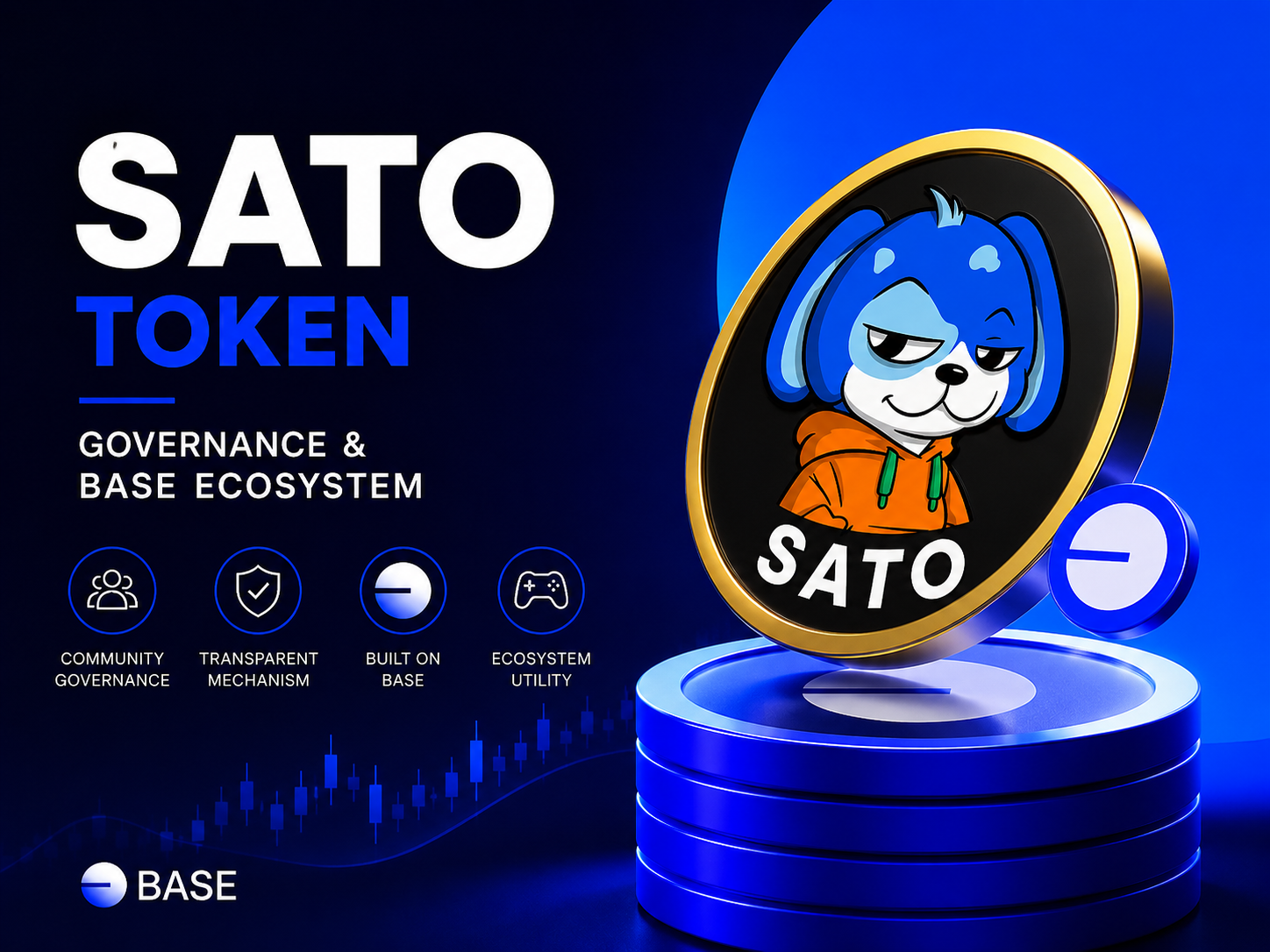
What Is the SATO Token
The core purpose of the SATO token is to support the Base Meme ecosystem that emerged after the Sato The Dog community takeover. It runs on the Base network and is positioned as a community driven Meme Coin, rather than a project token controlled by a single team over the long term.
Structurally, SATO’s value expression mainly comes from community consensus, onchain circulation, and ecosystem participation. According to official materials, SATO was initially issued as a Meme Coin. After the original development team stopped operating the project, community members took it over and rebuilt the ecosystem around transparent governance, community communication, and onchain applications.
SATO can be understood as the foundational onchain asset of the Sato The Dog community. By holding and using SATO, users participate in trading, community activities, NFT culture, and future application expansion within the Base ecosystem. Its role is not concentrated in one single function. Instead, it serves as a shared entry point for community collaboration and ecosystem interaction.
The importance of this design is that SATO extends the Meme Coin from a purely narrative asset into a tool for community organization. Its core is not complex protocol yield, but a sustained participation structure formed through public supply, community governance, and interaction on the Base chain.
How SATO’s Supply Structure Is Designed
SATO’s supply structure emphasizes full circulation and the absence of hidden allocations. The official website discloses that SATO has a total supply of 420.69B, a circulating supply of 100%, and runs on the Base network. The website also lists 0% buy tax, 0% sell tax, Ownership Renounced, and Liquidity Burnt.
The white paper further states that SATO has no team wallets, no Mint Function, and no Dev Tax. This means the project has no traditional authority to mint additional tokens and no hidden tax structure reserved for the development team.
| Item |
Data or Mechanism |
| Network |
Base |
| Total supply |
420.69B SATO |
| Circulating supply |
100% |
| Buy and sell tax |
0% buy tax, 0% sell tax |
| Minting function |
No Mint Function |
| Team wallet |
No Dev Wallets |
This supply structure shows that SATO’s token distribution logic is closer to a community circulation model than a team reserve or private sale allocation model. Since all tokens are already in circulation, SATO’s future ecosystem development depends more on community resource coordination than on a project team using newly issued tokens as incentives.
What Does SATO’s 0% Tax Mechanism Mean
SATO’s 0% tax mechanism means users do not pay an additional transaction tax set by the project contract when buying or selling the token. For a Meme Coin, transaction tax directly affects users’ entry and exit costs, as well as market liquidity and the trading experience.
From a mechanism perspective, the 0% tax rate reduces extra friction during onchain trading. When users buy or sell through a DEX or another trading venue that supports SATO, their costs mainly come from network fees, trading slippage, and liquidity depth, rather than extra buy or sell taxes charged by the project contract. The official website clearly shows SATO’s taxes as 0% buy and 0% sell.
First, a user initiates a SATO transaction on the Base network. The transaction is then matched through the corresponding liquidity pool. Next, the contract does not deduct any additional project tax because of the buy or sell action. In the end, the user’s trading result more directly reflects market price, slippage, and liquidity conditions.
The importance of this mechanism is that it reduces hidden fee structures and makes SATO easier to understand as a simple Meme Coin. For a community takeover project, 0% tax also helps reduce user concerns about contract complexity.
What Do Liquidity Burn and Ownership Renounced Do
The role of liquidity burning and Ownership Renounced is to reduce centralized control by the project side over the token’s trading environment and contract permissions. SATO’s official website discloses Liquidity as Burnt and Ownership as Renounced. These two mechanisms are commonly used to improve transparency for Meme Coins.
Liquidity burning means that control over the corresponding liquidity has been removed, making it difficult for the project side to withdraw that portion of liquidity. Ownership Renounced means contract ownership has been given up, so the project side can no longer adjust core parameters through owner privileges. Together, these mechanisms reduce the room for a single entity to interfere with token rules.
First, the project deploys the token contract and establishes liquidity. The liquidity control rights are then burned or removed. Next, contract ownership is renounced. In the end, SATO’s trading environment depends more on market and community behavior than on later modifications by the project side.
This structure does not mean the project has no risk, but it does strengthen its transparency. For a community takeover Meme Coin, liquidity burning and ownership renouncement help support the narrative foundation of being “community owned.”
The relationship between SATO and community governance is mainly reflected in Woof DAO, community voting, a multisig Treasury, and community proposal mechanisms. The white paper mentions that SATO’s Treasury is managed through a multisig wallet, key decisions are shared publicly, and the community also participates in shaping direction through voting.
Structurally, SATO is not a traditional corporate project. It is a community collaboration based Meme ecosystem. Woof DAO plays a governance coordination role within it. Although official materials state that Woof DAO has not yet been fully formalized, the community has already been advancing governance through multisig arrangements, public communication, and voting.
First, community members discuss ecosystem development, activities, NFTs, or communication direction. Multisig members then coordinate Treasury use based on community consensus. Next, the community participates in directional judgment through voting or proposals. In the end, governance outcomes affect SATO’s ecosystem resource allocation and the rhythm of community operations.
The importance of this governance approach is that it moves SATO’s token narrative beyond trading and connects it to community management and ecosystem collaboration. The relationship between token holders and community members becomes the key foundation for the project’s continued operation.
What Use Cases Does SATO Have in the Base Ecosystem
SATO’s use cases in the Base ecosystem mainly revolve around trading circulation, community identity, NFT culture, and onchain interaction. Its functions do not rely on complex protocols. Instead, SATO uses the Base network to support community participation and Meme communication.
The official website shows that SATO can be traded on Uniswap on the Base network and can also be accessed through centralized exchanges such as GroveX. It also displays SATO NFTs and Base Arena, with Base Arena described as a mini football game experience launched in collaboration between Krypto Cock Coin and SATO.
From an ecosystem structure perspective, SATO’s use cases include token trading, community activities, NFT based identity expression, Meme content distribution, and gamified interaction. First, users obtain SATO through the Base network. They then enter scenarios such as the community, NFTs, or Base Arena. Next, community content and onchain behavior increase ecosystem activity. Over time, SATO gradually becomes an entry point into Base Meme culture.
These use cases show that SATO is more like a community cultural asset than a single purpose protocol token. Its application value comes from the density of community participation, the ability to spread content, and onchain interaction scenarios on Base.
What Limitations Exist in SATO’s Token Mechanism
The limitations of SATO’s token mechanism mainly come from its Meme Coin nature, uncertainty in community governance, and the fact that its functional scenarios are still expanding. The 0% tax rate, burned liquidity, and absence of minting improve transparency, but they also mean the project lacks traditional token incentive tools.
Structurally, SATO has no Dev Wallets and no Mint Function, so the community cannot quickly create an incentive pool through new supply. The white paper also mentions that the earlier staking plan has ended and that, because all tokens are already in circulation, there are currently no plans to launch a new staking program.
On one hand, this structure reduces the risk of hidden allocation and additional issuance. On the other hand, it also makes ecosystem development more dependent on voluntary community collaboration, Treasury management, and external partnerships. If community activity declines, SATO’s application expansion and governance efficiency may also be affected.
For this reason, SATO’s mechanism is better understood as that of a community takeover Meme Coin. Its focus is transparency, fair circulation, and community autonomy, but it should not be equated with a complex yield model or a mature closed loop application ecosystem.
Conclusion
The role of the SATO token mainly appears in Base onchain circulation, community governance, NFT culture, and ecosystem interaction. It is not a token centered on complex protocol functions, but the foundational asset formed after the Sato The Dog community takeover.
From a supply structure perspective, SATO has a total supply of 420.69B, 100% circulation, and adopts mechanisms such as 0% buy and sell tax, no Mint Function, no Dev Wallets, burned liquidity, and Ownership Renounced.
From an ecosystem function perspective, SATO participates in community building through modules such as Woof DAO, community proposals, a multisig Treasury, NFTs, and Base Arena. Its strengths lie in transparency and community autonomy, while its limitations come from the fact that functional expansion and long term operation depend heavily on community collaboration.
FAQs
What Is the SATO Token
SATO is the Base Meme Coin in the Sato The Dog ecosystem. It is used to support community circulation, community governance, NFT culture, and onchain interaction. After the community takeover, holders and community members jointly pushed the ecosystem forward.
What Is SATO’s Total Supply
According to SATO’s official website, the total supply is 420.69B, with 100% circulating supply. The white paper also states that SATO has no Mint Function and no Dev Wallets.
Does SATO Have Transaction Tax
SATO has 0% buy tax and 0% sell tax. This means users are not charged extra buy or sell taxes by the project contract when trading the token. Trading costs mainly come from network fees, slippage, and liquidity conditions.
What Does SATO’s Ownership Renounced Mean
Ownership Renounced means contract ownership has been given up, so the project side can no longer modify core contract parameters through owner privileges. This mechanism helps reduce the risk of centralized control.
SATO’s governance mainly operates through Woof DAO, a multisig Treasury, community voting, and proposal based collaboration. Community members can participate in discussions around ecosystem development, resource use, and activity direction.
What Is SATO Used for in the Base Ecosystem
SATO can be used for Base onchain trading, community participation, NFT cultural expression, and interactive scenarios such as Base Arena. It is closer to a community cultural asset than a single function protocol token.