Blockchain games simultaneously demand "high TPS, low Gas, predictable confirmation times" and "comprehensive asset, NFT, cross-chain, and stablecoin support" from underlying public chains—requirements that traditional general-purpose chains rarely fulfill all at once. WEMIX3.0 was created in this context, originating from game publishing and a full-stack ecosystem, and features specialized designs for its consensus mechanism, network topology, and economic model to strike the right balance between user experience and on-chain security, especially for large MMORPGs and multi-token economies.
From a broader infrastructure standpoint, WEMIX3.0 exemplifies an engineering paradigm of "game public chain + integrated financial foundation." Built atop Go-Ethereum, it introduces network layering, accelerated block production, and revamped trading fee mechanisms, along with RAFT-style leader election and SPoA node access. With unagi and Chainlink CCIP, it connects nine major public chains into a cross-chain addressable asset network. The Brioche hard fork further refines its token system and multi-stablecoin solutions, enabling the chain to simultaneously serve gaming, DeFi, NFT, and real-world payment use cases.
The following analysis systematically explores WEMIX3.0’s technical architecture across eight dimensions: network architecture, development environment, consensus mechanism, scalability, cross-chain protocol, stablecoin system, technical strengths and weaknesses, and future roadmap.
WEMIX3.0 Overall Network Architecture
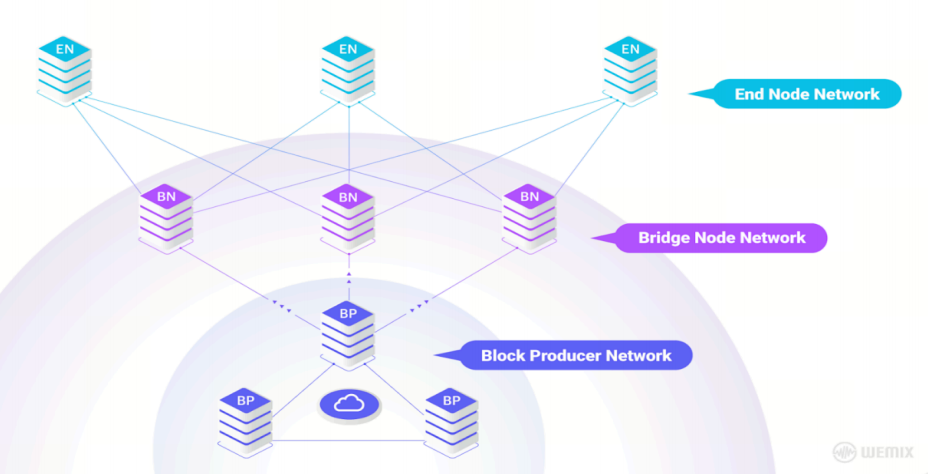
WEMIX3.0 is a secondary development based on Go-Ethereum (v1.10.16+), restructuring the original Ethereum network—centered on single-node roles—into a three-layer logical architecture. This allows consensus, network isolation, and external access to be handled by different node groups, ensuring both security and openness.
The core layer, BPN (Block Producer Network), consists of 40 NCPs dedicated to block production and consensus voting. BPN uses the RAFT algorithm for internal leader election and is accessible only to trusted nodes, safeguarding high-frequency block production from external malicious traffic. The middle layer, BNN (Bridge Node Network), acts as a "firewall" and relay: it filters, verifies, and forwards transaction requests from the ENN, provides initialization data for new nodes, and isolates BPN from public attack vectors.
The outermost ENN (End Node Network) is open to the public. Any user, exchange, or dApp backend can operate an ENN node to access on-chain data, submit transactions, and synchronize state. This three-layer structure allows WEMIX3.0 to remain publicly accessible while keeping critical consensus hash power and network topology within a trusted boundary—providing the foundation for large-scale blockchain game hosting and high-frequency settlements.
EVM Compatibility and Development Environment
WEMIX3.0 is fully compatible with Ethereum mainnet at the execution layer. Developers can write Smart Contracts in Solidity and use familiar toolchains like Hardhat, Foundry, Truffle, and Remix for compiling, testing, and deployment—no need to learn a new contract language or VM. The account system follows the Ethereum standard ECDSA Private Key and hexadecimal address format, so wallets such as MetaMask, Rabby, and Coinbase Wallet can connect directly after RPC configuration.
For data access, WEMIX3.0 offers a comprehensive suite of dApp APIs—covering Account, Block, Contract, Transaction, Event Logs, and Tokens modules—to support balance queries, contract calls, event subscriptions, and token metadata. Combined with its official block explorer and GraphQL indexing service, developers can quickly build wallets, marketplaces, analytics dashboards, or game backends.
For gaming, WEMIX## How WEMIX Builds a Blockchain Gaming Ecosystem further extends EVM compatibility with the WEMIX PLAY Developer Console and Technical Integration Guide, offering unified login, built-in wallet, event templates, and on-chain SDK. This compresses Web3 integration time from months to weeks—a key reason over 47 blockchain games have joined the ecosystem.
How the SPoA Consensus Mechanism Works
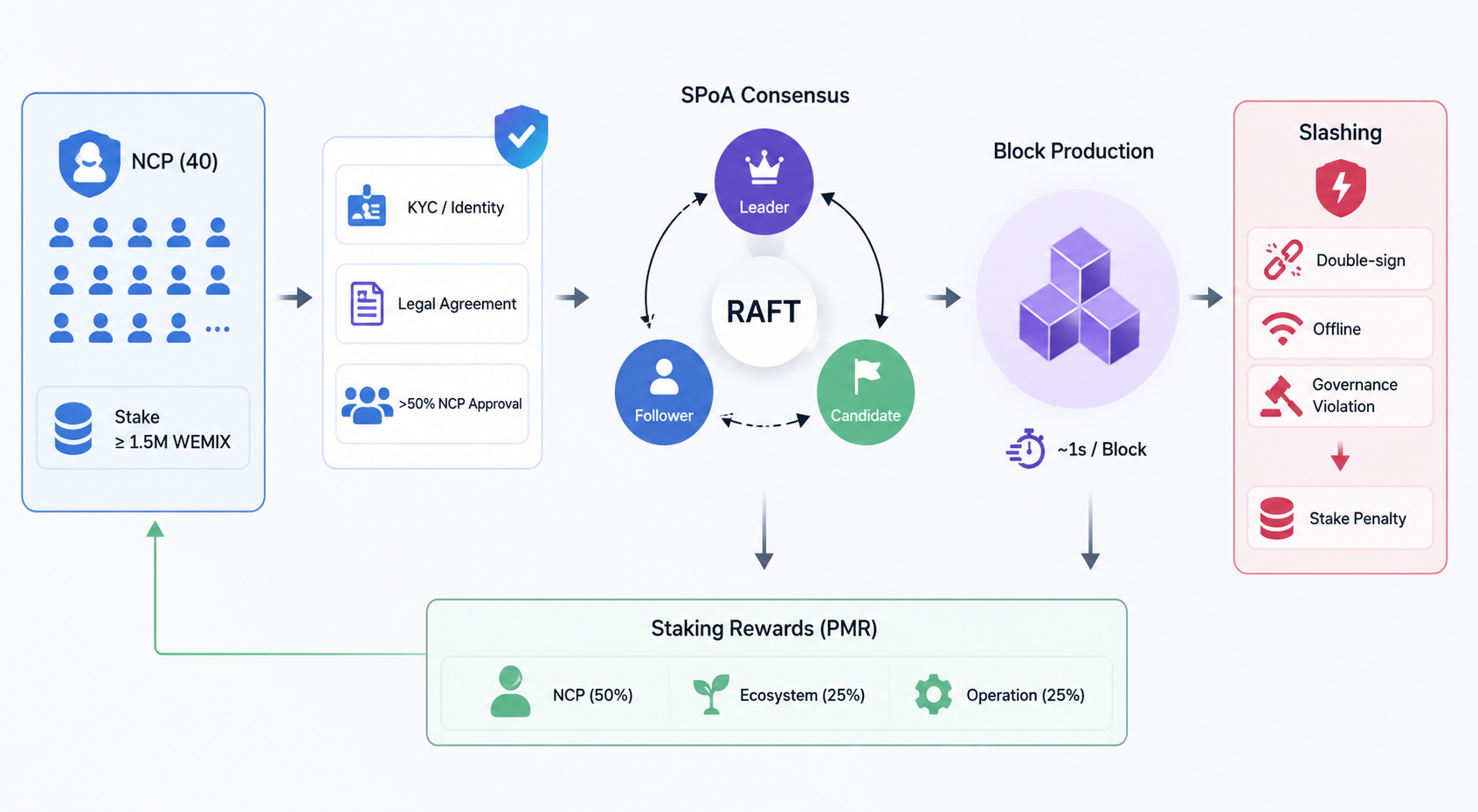
WEMIX3.0 utilizes the SPoA (Stake-based Proof of Authority) consensus mechanism, combining the "identity access" of classic PoA with the "economic staking" of PoS to achieve higher block production efficiency and clearer accountability. Only 40 certified NCPs are eligible to produce blocks, each required to stake at least 1.5 million WEMIX, undergo identity verification, sign legal contracts, and receive majority approval from existing NCPs before joining the consensus committee.
If a node experiences prolonged downtime, double-signs, or violates governance decisions, its staked WEMIX may be partially or entirely confiscated. This "real-name + staking + legal" triple constraint means SPoA, while less decentralized than fully open PoS, delivers much higher security redundancy than traditional PoA.
At the protocol level, BPN uses the RAFT (Reliable And Fault Tolerant) protocol for leader election and log replication. Nodes can be Leader, Follower, or Candidate; Leaders periodically send heartbeats to Followers, and if a Follower does not receive a heartbeat within a random timeout, it initiates a new election. Since Phase 2, all NCPs have equal voting power in governance, so WEMIX3.0 maintains block production efficiency while avoiding "winner-takes-all" governance imbalances based on token holdings.
Performance optimization is a core differentiator for WEMIX3.0 versus general-purpose Ethereum environments. At the block production level, WEMIX3.0 reduces block time from about 12 seconds on Ethereum mainnet to around 1 second, dramatically lowering transaction confirmation and in-game feedback latency. For block capacity, the default per-block Gas limit is raised to 105 million—about 3.5 times Ethereum mainnet—allowing more transactions at peak load and a theoretical throughput of about 4,000 TPS.
For trading fee mechanisms, WEMIX3.0 fully implements EIP-1559, dynamically calculating BaseFee per block based on prior block fill and burning a portion of Gas, making fees more predictable and linking fee models to long-term token supply. The Brioche hard fork halves per-block PMR from 1 WEMIX to 0.5 WEMIX and caps total supply at 590 million tokens, boosting scalability while further reducing inflationary pressure.
At the node level, the three-layer network allows horizontal scaling of BNN and ENN to absorb external read/write demand without changing the BPN's internal 40-node consensus. Looking ahead, Phase 3 will introduce dynamic selection of the top 40 nodes by staking rank, offering further evolution in decentralization and scalability.
Cross-Chain and Multi-Chain Ecosystem Support
WEMIX's cross-chain strategy centers on unagi (Unbound Networking & Accelerating Growth Initiative)—a full-chain network built by the WEMIX Foundation for Web3 gaming and full-stack applications. As of now, unagi supports nine major public chains, including Arbitrum, Avalanche, BNB Chain, Ethereum, Optimism, Klaytn, Kroma, Polygon, and WEMIX3.0, covering major Ethereum L2s and multiple game-oriented chains.
Technically, unagi(x) uses Chainlink CCIP as its exclusive cross-chain messaging infrastructure, leveraging decentralized oracles for secure cross-chain messaging and token transfers, so developers can achieve "messaging + asset" cross-chain functionality without building their own bridges. Around unagi(x), WEMIX has developed una Messenger (a full-chain communications platform for token-gated communities), Una Swap (enabling cross-chain swaps in a single transaction and using mudskipper for destination chain Gas), and Unagi Naming Service (uNS, providing unified, readable identities for multi-chain wallets).
On the governance side, WEMIX and partners like Chainlink Labs have established the COURT (Certified Organizations for Unagi Round Table) alliance to set protocol standards, coordinate routing, and oversee operational risks, making unagi not just a toolkit but a sustainable multi-chain collaboration framework.
WEMIX Stablecoin and On-Chain Financial System
To support high-certainty scenarios like in-game purchases, NFT settlement, and cross-border payments, WEMIX3.0 adopts a "native stablecoin + bridged stablecoin" dual-track system. The native stablecoin WEMIX$ is managed by the DIOS Protocol, aiming for a near-dollar peg via on-chain collateral and algorithmic mechanisms, directly serving the WEMIX ecosystem.
In June 2025, WEMIX3.0 mainnet will officially launch USDC.e (a bridged version of Ethereum-native USDC) in partnership with Circle and Chainlink, using the classic Burn-and-Mint model: users burn an equivalent amount of USDC on Ethereum mainnet to mint the same amount of USDC.e on WEMIX3.0, bringing one of the world’s most liquid, compliant stablecoins to the WEMIX network. The WEMIX$$ Module Service provides a 1:1 exchange channel (10,000 WEMI$$ daily per address, maximum three transactions) and allows USDC.e to be converted back to USDC for withdrawal to centralized exchanges.
On top of stablecoins, WEMIX.Fi serves as the ecosystem’s DeFi hub, integrating token swaps, yield farming, liquidity staking, and portfolio management, with a new Relaunch and Claim upgrade completed in January 2026. WEMIX Pay applies stablecoins and native tokens to in-game purchases and third-party payments, equipping the public chain with end-to-end settlement, finance, and payment capabilities.
WEMIX Technical Strengths and Potential Limitations
WEMIX3.0’s technical strengths are evident in four key areas: (1) high-performance design for gaming, with 1-second blocks, 4,000 TPS, and EIP-1559 dynamic Gas for high-frequency interactions; (2) an Ethereum-like developer experience, enabling Web3 teams to migrate contracts and tools at zero cost; (3) mature cross-chain capabilities via unagi(x) + Chainlink CCIP, connecting nine major public chains; and (4) a complete suite of on-chain financial modules—including stablecoins, DEX, staking, and payments—for complex in-game economies.
Structural limitations must also be acknowledged. First, the 40-node SPoA is still a transitional form between consortium and public chains, less decentralized than fully open PoS networks. Second, cross-chain bridges and stablecoin layers are high-value attack targets, as seen in the Play Bridge Vault incident in early 2025, which exposed gaps in security audits and monitoring. Third, PoA consensus relies heavily on node compliance and is closely tied to the lead party, Wemade’s business status, and Korean regulatory trends, so external investors must account for this risk premium.
These coexisting strengths and limitations make WEMIX3.0 a distinctive, long-term "specialized public chain" case worth close observation.
Future Upgrade Directions for WEMIX3.0
According to the official roadmap, WEMIX3.0 will continue to evolve along three lines: "consensus openness, economic convergence, and deepening cross-chain integration." At the consensus layer, Phase 3 plans to transition from SPoA to open PoS, allowing all stakers to compete for validator roles, with the top 40 nodes periodically selected for block production—making node access more market-driven while retaining high throughput and low latency.
Economically, after the Brioche hard fork, WEMIX has sharply tightened its inflation curve through major token burns, PMR halving, and a 590 million token supply cap. From July 2025, a temporary incentive period will raise WEMIX Stake rewards from 0.5 to 1 WEMIX per block (through December 2025) to encourage long-term staking and strengthen consensus security.
On the cross-chain and ecosystem side, unagi will continue to expand supported chains and enrich modules like Una Swap, una Messenger, and uNS, while COURT will drive cross-chain governance and standards. Coupled with WEMIX Pay’s expansion into a universal payment platform, WEMIX.Fi’s Relaunch in early 2026, and future research into AI and on-chain agents, WEMIX3.0 is poised to evolve from a "game-specific public chain" to a "high-performance EVM network for multiple scenarios."
Summary
In summary, WEMIX3.0 is an EVM-compatible public chain deeply optimized for gaming and full-stack ecosystems: it achieves high performance through a three-layer network, SPoA + RAFT consensus, and 1-second block times; enables interoperability across nine chains via unagi(x) + Chainlink CCIP; delivers a complete stablecoin and DeFi module with WEMIX$, USDC.e, and WEMIX.Fi; and continually converges token supply via the Brioche hard fork and buyback mechanisms.
However, the relative centralization of 40 nodes, security pressures on bridged assets, and Korean regulatory risks remain real constraints. For professionals focused on Web3 gaming, on-chain economic infrastructure, and multi-chain protocol architecture, WEMIX3.0 is both a prime example of a "full-stack game public chain" and a key reference point for assessing the long-term viability of specialized Layer 1s.