Users searching for Injective vs Sei are typically aiming to understand the differences between these two high-performance public blockchains in architecture, trade execution, and ecosystem positioning. Both are designed for high-frequency applications and on-chain trading, but their foundational designs differ significantly.
This topic usually involves comparisons across underlying architecture, order execution, incentive mechanisms, data control, ecosystem applications, and use-case scenarios. Only by analyzing these dimensions separately can we avoid oversimplifying both as simply “high-performance public blockchains.”
What Is Injective
Injective is a Layer 1 public blockchain purpose-built for on-chain financial scenarios, with its core focused on delivering native infrastructure for trading, derivatives, cross-chain assets, and financial applications. Rather than serving as a generic smart contract platform, Injective is engineered to build an on-chain trading network centered around financial execution.
From an architectural perspective, Injective is built on the Cosmos SDK and integrates IBC, CosmWasm, order book modules, and financial application modules. According to official sources, Injective is a high-performance Layer 1 optimized for DeFi applications, with a strong emphasis on scalability, security, and interoperability.
Users can engage in spot, derivatives, and cross-chain asset trading on Injective. The platform processes trade requests through its on-chain order book and validator network, allowing applications to leverage native financial modules to build products. Ultimately, Injective’s ecosystem is structured around trading and financial markets.
This design is significant because Injective embeds trading infrastructure directly on-chain, eliminating the need for external applications to independently build matching and settlement systems.
What Is Sei
Sei is a Layer 1 blockchain designed for high-performance applications and trading scenarios, focusing on boosting the efficiency of on-chain applications through parallel execution, optimized consensus, and EVM compatibility. Sei’s scope extends beyond financial use cases to any on-chain application demanding low latency and high throughput.
Architecturally, Sei employs technologies such as Twin Turbo Consensus, parallel execution, and SeiDB. According to official documentation, Twin Turbo Consensus targets low finality times of around 400 milliseconds and enhances transaction throughput via block construction and consensus optimization.
On Sei, users submit trades or invoke applications; the system then processes these through optimized consensus and parallel execution. Underlying components like SeiDB further improve state access efficiency, and developers can deploy high-performance applications within the Sei EVM environment.
This mechanism means Sei places a premium on execution efficiency and the EVM developer experience, making it ideal for applications that require rapid confirmation and high concurrency.
How Do Injective and Sei Differ in Underlying Architecture
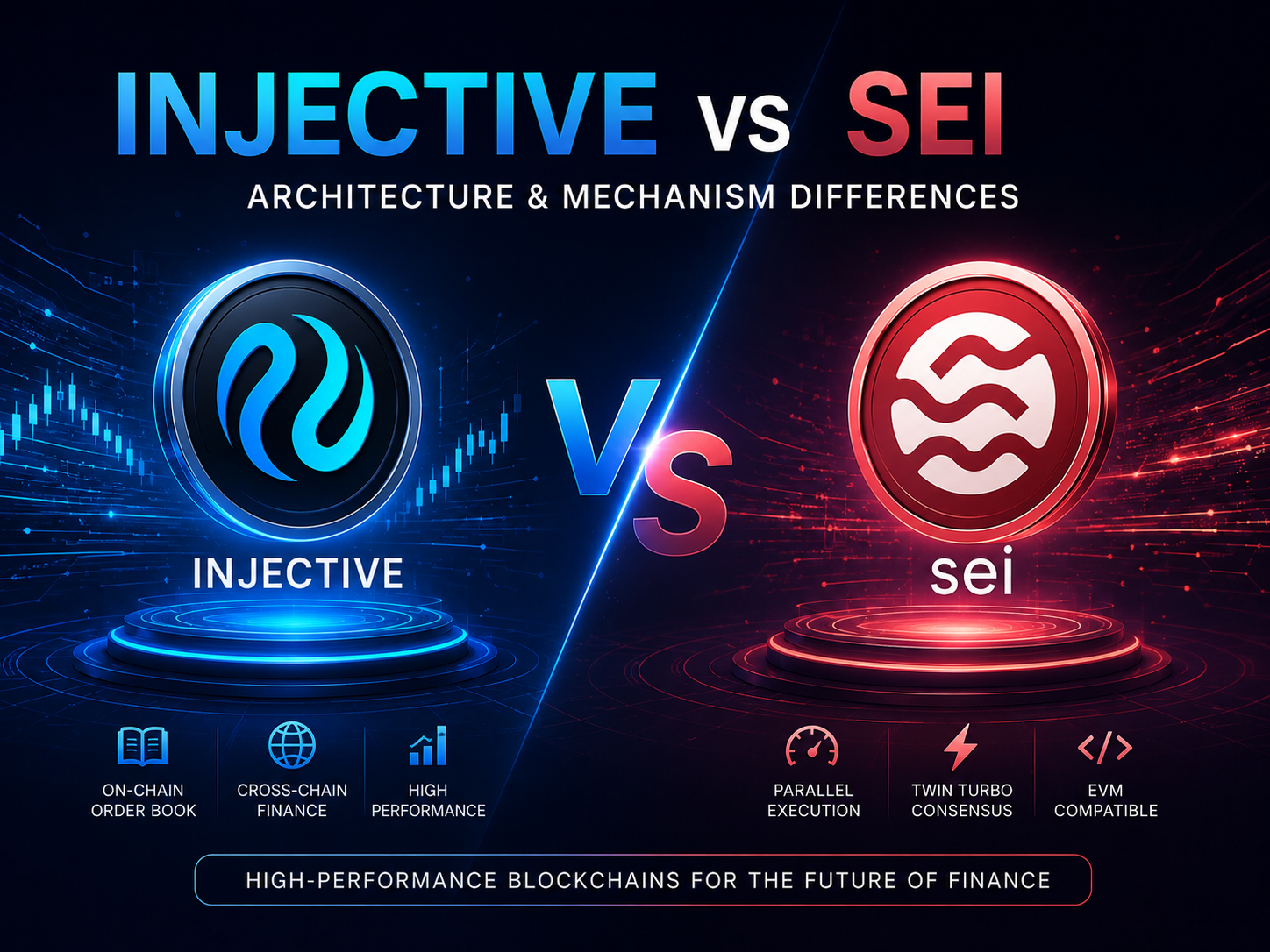
The architectural divergence between Injective and Sei lies in Injective’s financial modularity versus Sei’s focus on high-performance execution environments. Injective is architected around order books, cross-chain assets, and financial modules, while Sei is built around consensus optimization, parallel execution, and EVM extensibility.
Injective relies on the Cosmos SDK and IBC for interoperability, supporting on-chain trading, derivatives, and cross-chain finance through native modules. Sei prioritizes Twin Turbo Consensus, the Parallelization Engine, and SeiDB, which are core to boosting throughput, enabling parallel trade execution, and optimizing state access.
| Comparison Dimension |
Injective |
Sei |
| Core Positioning |
On-chain financial infrastructure |
High-performance EVM public blockchain |
| Architectural Focus |
Financial modules, cross-chain interoperability |
Consensus optimization, parallel execution |
| Trading Structure |
Native order book, financial modules |
High-throughput trade execution |
| Development Environment |
Cosmos, CosmWasm, MultiVM |
Sei EVM, developer tools |
| Ecosystem Direction |
DeFi, derivatives, RWA |
High-frequency apps, DeFi, EVM applications |
This comparison highlights that Injective’s strength lies in its native financial capabilities, while Sei’s advantage is in execution performance. Both are built for high-performance scenarios, but each follows a distinct technical path.
How Do Injective and Sei Differ in Order Execution Mechanisms
Injective’s order execution mechanism closely resembles an on-chain exchange model, while Sei’s is more akin to a high-performance application chain. Injective processes trades via an on-chain order book and batch auction mechanism; Sei boosts confirmation speeds through parallel execution and rapid consensus.
On Injective, users submit orders to the on-chain order book, which are then matched and batch processed to reduce MEV impact. Settlement occurs on-chain, prioritizing order management, price discovery, and fairness in financial trading.
Sei’s process emphasizes throughput and execution efficiency. Trades are submitted by users or applications, then processed through Twin Turbo Consensus for optimized block propagation and consensus, with parallelizable transactions handled simultaneously. Trades are confirmed rapidly, with documentation emphasizing parallel execution and low finality as core performance features.
Injective is thus ideal for scenarios requiring order books, derivatives, and financial market structures, while Sei is better suited for high-frequency, EVM-compatible, and concurrent trading applications.
How Are Injective and Sei’s Incentive Mechanisms Designed
Both Injective and Sei center their incentive mechanisms on PoS network security, but their economic designs differ. Injective emphasizes INJ governance, staking, and burn mechanisms, while Sei focuses on SEI staking, validator security, and network participation.
INJ functions as both a governance and staking token on Injective, with burn mechanisms like Burn Auction reducing supply by auctioning off a portion of ecosystem fees and revenues. According to official sources, this ties protocol revenue directly to token burns.
SEI is used for network fees, staking, and governance on Sei. Staking is a core element, with validators and delegators maintaining network security and consensus through delegated proof of stake.
On both chains, users can participate in staking, with the validator network ensuring security. Token rewards and governance rights are distributed to participants, forming a closed economic loop. The distinction is that Injective highlights protocol revenue and burning, while Sei emphasizes staking and validator participation in a high-performance context.
How Do Injective and Sei Differ in Data Control
Injective’s data control focuses on financial trading data and cross-chain asset state management; Sei’s is oriented toward high-throughput state access and parallel execution. Both require efficient on-chain data processing, but their data service objectives differ.
Injective manages order book data, trade status, cross-chain asset records, and market parameters. Users submit trades or orders, which are recorded alongside account balances. On-chain modules handle matching, settlement, and cross-chain information, enabling applications to build trading markets from this data.
Sei’s data control is designed for execution performance. SeiDB optimizes state access, working with parallel execution and consensus optimization to enhance throughput. Official documentation lists SeiDB, Twin Turbo Consensus, and parallel execution as core performance components.
This means Injective is focused on how financial data enters the trading system and is settled, while Sei is focused on rapid reading, execution, and confirmation of large transaction volumes.
How Do Injective and Sei Differ in Ecosystem Applications
Injective’s ecosystem is concentrated on on-chain finance, while Sei’s is positioned as a high-performance EVM application platform. Both support DeFi, but their ecosystem priorities vary.
Injective applications typically revolve around decentralized trading, perpetual futures, cross-chain assets, RWA, and financial markets. With native order book and cross-chain modules, developers can easily build financial products centered on trading and liquidity.
Sei’s ecosystem spans DeFi, trading applications, NFTs, gaming, social, and other high-frequency on-chain use cases. Sei’s documentation highlights Sei EVM, precompiled contracts, Solidity tools, and cross-VM communication—indicating a strong focus on EVM application migration and high-performance execution.
Developers select the underlying network based on their application’s needs: financial applications prioritize trading modules and liquidity, while high-frequency interactive applications prioritize execution efficiency and compatibility. As a result, Injective and Sei naturally divide their ecosystem focus.
What Scenarios Are Injective and Sei Best Suited For
Injective is best suited for on-chain financial markets, while Sei excels in high-performance EVM applications and low-latency interactions. They are not direct substitutes, but offer differentiated advantages for various needs.
Injective is ideal for projects requiring order books, derivatives, cross-chain assets, and financial settlement—such as decentralized trading platforms, perpetual futures markets, RWA trading, and on-chain structured products.
Sei is optimal for applications demanding high throughput, low latency, and EVM compatibility—such as high-frequency DeFi, on-chain gaming, consumer applications, trading aggregators, and large-scale interactive platforms.
Project teams should assess whether their applications require financial modules, evaluate trade frequency, user interaction, and development environment, and select the most suitable on-chain execution layer. Ultimately, the application scenario will determine whether Injective or Sei is the better fit.
Summary
The crucial difference between Injective and Sei isn’t which is faster, but which core scenarios each serves.
Injective focuses on on-chain financial infrastructure, including order books, derivatives, cross-chain assets, and the INJ economic model. Sei emphasizes execution performance, featuring Twin Turbo Consensus, parallel execution, SeiDB, and EVM application expansion.
Users should first define their application’s requirements, then compare financial modules, execution performance, and ecosystem compatibility, assess incentive mechanisms and data structures, and finally determine whether Injective or Sei is the best match for their use case.
FAQ
What is the biggest difference between Injective and Sei?
Injective is focused on on-chain financial infrastructure—order books, derivatives, and cross-chain assets—while Sei is built for high-performance EVM execution, prioritizing low latency, parallel execution, and application extensibility.
Are both Injective and Sei suitable for DeFi?
Both are suitable for DeFi, but with different emphases. Injective is better for order book trading and derivatives markets, while Sei is better for DeFi applications needing high throughput and low-latency interactions.
What does Sei’s Twin Turbo Consensus do?
Twin Turbo Consensus optimizes block propagation and consensus efficiency, aiming to accelerate transaction confirmations and on-chain throughput, making Sei well-suited for high-frequency applications.
What are the advantages of Injective’s order book mechanism?
Injective’s order book supports limit orders and matching logic similar to traditional trading markets, making it ideal for derivatives, spot trading, and professional financial use cases.
Which is more suitable for developers, Injective or Sei?
If you’re focused on financial modules and on-chain trading infrastructure, Injective is the better fit. If you prioritize EVM compatibility, high throughput, and low-latency applications, Sei is the better choice.







