Users researching the Injective cross-chain mechanism are typically seeking to understand how assets move from networks like Cosmos or Ethereum into Injective, and how those assets can participate in on-chain trading, derivatives, DeFi applications, or liquidity markets. For financial public blockchains, cross-chain capability directly impacts asset origination, market depth, and application availability.
This topic generally involves a three-layer structure: IBC enables interoperability within the Cosmos ecosystem, Peggy Bridge connects Ethereum assets, and Injective Bridge consolidates multiple cross-chain pathways to serve as the entry point for asset flows for both users and applications. Official documentation indicates that Injective Bridge leverages technologies like Peggy and IBC to facilitate cross-chain asset transfers.
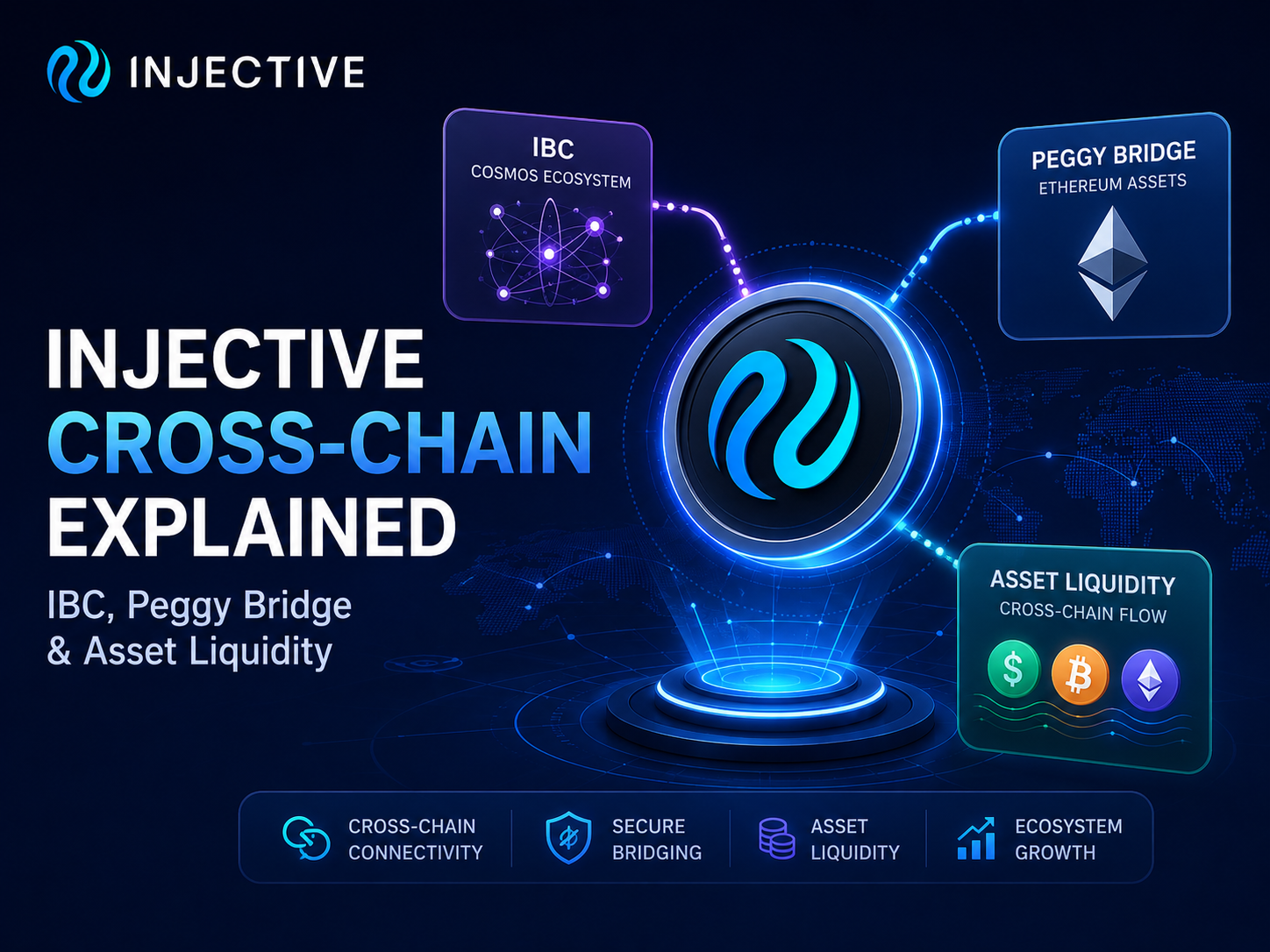
What Is Injective's Cross-Chain Mechanism
Injective's cross-chain mechanism is best understood as a comprehensive system for asset and message interoperability, designed to enable assets from diverse blockchains to enter the Injective network and be utilized in on-chain financial applications. Rather than a single bridge, it consists of multiple interoperable components—IBC, Peggy Bridge, Wormhole, and others—forming a robust cross-chain infrastructure.
The core function is to convert external assets into on-chain representations that are identifiable, tradable, and settleable on Injective. The process begins with users selecting source and target chains; the cross-chain system then verifies asset lock or transfer requests; the Injective network subsequently generates or receives the corresponding asset representation; and finally, users can deploy these assets across Injective's trading, lending, or derivatives platforms.
Structurally, Injective's cross-chain mechanism is engineered for on-chain finance—not just simple asset transfer. Official resources highlight that IBC allows for the transfer of assets and arbitrary messages between chains, enabling multiple independent networks to participate in a unified ecosystem.
This mechanism is critical because Injective's order book, derivatives, and DeFi applications require support from a diverse set of assets. The stronger the cross-chain capability, the broader the range of collateral, trading assets, and liquidity sources accessible to Injective.
How Does IBC Operate Within Injective
IBC is the foundational protocol connecting Injective to the Cosmos ecosystem. Serving as the communication standard across Cosmos networks, IBC enables the transfer of assets, data, and cross-chain messages between blockchains.
Within Injective, IBC operates through light client verification and channel connections between chains. Users initiate transfers from IBC-enabled Cosmos chains; the source chain records the asset transfer and generates a cross-chain message; a relayer then transmits this message to Injective; and finally, Injective verifies the message and updates the user's asset balance.
Unlike traditional custodial bridges, IBC functions as an inter-chain communication protocol, standardizing channels and verification logic so multiple Cosmos networks can recognize each other's state changes. Injective’s governance has actively promoted IBC integration, further expanding Injective’s reach within the Cosmos ecosystem.
This means assets from the Cosmos ecosystem can flow into Injective’s on-chain financial environment. For users, IBC reduces the cost of moving assets cross-chain; for applications, it expands the available asset universe and deepens trading markets.
How Does Peggy Bridge Connect Ethereum Assets
Peggy Bridge links Injective to the Ethereum ecosystem, enabling Ethereum assets such as ERC-20 tokens to enter the Injective network. It functions as Injective’s native cross-chain bridge for Ethereum.
The process centers on asset locking, verification, and mapping. Users submit asset bridging requests on the Ethereum side; Peggy Bridge contracts or modules confirm asset status; Injective then generates the corresponding asset representation based on verification; and users can utilize these Ethereum assets for trading or DeFi on Injective.
Peggy Bridge connects Ethereum’s asset layer with Injective’s financial execution layer. Official resources note that Injective Bridge utilizes Peggy for cross-chain interactions, supporting asset flows between Injective and other blockchains.
Peggy Bridge is essential because the Ethereum ecosystem offers a vast supply of stablecoins, mainstream assets, and DeFi liquidity. Through Peggy Bridge, Injective can integrate Ethereum assets into its on-chain order book and financial applications—beyond just Cosmos-based assets.
How Does Injective Enable Cross-Chain Asset Flows
Injective’s cross-chain asset flow relies on coordination between the source chain, bridge protocol, verification modules, and target chain accounts. Assets are not simply transferred from one wallet to another—they undergo on-chain confirmation, cross-chain messaging, and accounting updates on the target chain.
A typical workflow includes the following stages:
| Process Stage |
User Action |
System Action |
| Initiate Cross-Chain |
Select source chain, target chain, and asset |
Generate cross-chain request |
| Source Chain Confirmation |
Submit transaction |
Asset is locked or transferred |
| Message Transmission |
Await confirmation |
Relayer or bridge module transmits data |
| Target Chain Accounting |
Check balance |
Injective confirms asset representation |
| Application Use |
Trade or provide liquidity |
Asset enters on-chain financial use case |
This workflow shows that cross-chain mechanisms involve both user actions and system-level verification. Users see assets move from one network to another, while the system ensures consistency between asset states, message proofs, and account balances.
Afterward, users can deploy cross-chain assets in Injective’s Spot market, derivatives market, or other DeFi applications. Ultimately, these assets contribute to order book depth, collateral pools, and trading pairs, directly impacting liquidity efficiency across the Injective ecosystem.
How Cross-Chain Mechanisms Affect Injective’s Liquidity
The impact of cross-chain mechanisms on Injective’s liquidity is seen in asset origination, trading depth, and application diversity. On-chain financial protocols require various assets for trading, collateralization, and settlement, so cross-chain capability determines how much external capital and which asset types Injective can attract.
The key is unlocking capital entry points across ecosystems. Through IBC, Cosmos assets can enter Injective; with Peggy Bridge, Ethereum assets can participate in Injective markets; and other cross-chain frameworks allow even more non-Cosmos assets to be integrated. Injective’s Ionic Upgrade further consolidates IBC, Wormhole, and Peggy Bridge, enabling users to bridge IBC assets, Wormhole-supported assets, and ERC-20 tokens.
Cross-chain liquidity is not just a single asset inflow, but a tradable asset pool formed by multiple ecosystems. External assets enter Injective; users deploy them for trading or liquidity provision; applications gain deeper markets and more trading pairs; and the on-chain financial ecosystem achieves higher capital utilization.
This means Injective’s competitiveness relies not only on its native user base, but also on its ability to attract assets from external ecosystems.
Key Features of Injective's Cross-Chain Security Mechanism
Injective’s cross-chain security is built around verification, message transmission, and on-chain confirmation. The main challenge is ensuring consistency between the source chain’s state and the target chain’s accounting—not just speed.
IBC’s security is rooted in inter-chain verification and standardized communication. Using light clients, channels, and relayers, IBC enables target chains to verify source chain messages. Unlike fully centralized custodial bridges, IBC prioritizes protocol-level validation.
Peggy Bridge emphasizes secure asset mapping between Ethereum and Injective. Users initiate actions on Ethereum; the bridge system verifies transactions; Injective processes the corresponding assets based on verification; and assets are made available on the target chain.
Injective’s security framework consists of on-chain contracts, validator networks, cross-chain modules, and relay systems. Official documentation confirms that Injective Bridge leverages Peggy and IBC for cross-chain interactions, meaning different asset routes use different security models.
This design allows Injective to select the appropriate cross-chain framework for each source chain, rather than exposing all assets to a single bridge risk model.
Challenges Facing Injective's Cross-Chain Architecture
Injective’s cross-chain architecture faces challenges related to bridge security, liquidity fragmentation, user experience, and the complexity of maintaining multiple protocols. As cross-chain capability expands, the system must manage more asset standards, network states, and security assumptions.
Different cross-chain protocols—IBC, Peggy Bridge, Wormhole—each have unique risk models, verification methods, and operational logic. When users move assets across networks, factors like transaction confirmation times, trading fees, wallet compatibility, and asset display can all affect the experience. Once assets enter Injective, sufficient trading demand and application support are essential; otherwise, liquidity may remain idle on-chain.
While multi-chain integration increases asset coverage, it also raises system coordination costs. Cross-chain assets must be clearly labeled with source, standards, and risk attributes, or users may struggle to distinguish between native, bridged, and mapped assets.
Ultimately, the effectiveness of Injective’s cross-chain architecture depends on balancing security, user experience, application demand, and market depth. Cross-chain capability is not just a feature—it is foundational to the long-term operation of the Injective financial ecosystem.
Summary
Injective’s cross-chain mechanism is built around IBC, Peggy Bridge, and multi-chain bridging frameworks, with the goal of bringing Cosmos, Ethereum, and other ecosystem assets into Injective’s on-chain financial system.
From a process perspective, users initiate a cross-chain request, the source chain confirms asset status, the cross-chain module transmits and verifies messages, and Injective confirms the user’s asset balance—enabling participation in trading, derivatives, or DeFi applications.
IBC strengthens Cosmos ecosystem interoperability, Peggy Bridge connects Ethereum assets, and a unified bridging architecture expands Injective’s asset coverage. In short, cross-chain mechanisms impact not only asset transfers, but also Injective’s liquidity, market depth, and financial application scalability.
FAQ
What is the primary purpose of Injective’s cross-chain mechanism?
Injective’s cross-chain mechanism is primarily designed to connect assets from different blockchains, enabling Cosmos, Ethereum, and other ecosystem assets to enter Injective and participate in on-chain trading, DeFi, and financial markets.
What role does IBC play in Injective?
IBC connects Injective to the Cosmos ecosystem. It uses inter-chain communication protocols to transfer assets and messages, allowing various Cosmos networks to interoperate with Injective.
How does Peggy Bridge connect Ethereum?
Peggy Bridge uses Ethereum-side contracts and Injective modules to process asset status, enabling ERC-20 and other Ethereum assets to be mapped or transferred into the Injective network.
What use cases exist for Injective cross-chain assets?
Injective cross-chain assets can be used for Spot trading, derivatives, collateralization, liquidity provision, and other on-chain financial applications, depending on asset support and application integration.
What are the risks associated with Injective’s cross-chain mechanism?
Key risks include bridge security, cross-chain message delays, asset standard discrepancies, liquidity fragmentation, and user operation errors. Each cross-chain route involves a distinct security model.







